
Why TinMan Exists
Automation is everywhere — but understanding automation has always been difficult. Machines move fast, operate under stress, and degrade silently. Traditional tools show symptoms, not causes. TinMan Systems exists to change that.
Our purpose is simple: give automated systems the ability to communicate their health in real time. When equipment communicates its condition, operators can act with clarity and confidence.
Where We Started

TinMan Systems began as a software foundation — a real‑time, multi‑input/multi‑output architecture built to give mechanical systems the ability to understand and express their own behavior. Long before TinMan became a company, the core ideas were already taking shape: deterministic computation, synchronized sensing, embedded knowledge, and a modular environment for constructing intelligent system logic.
In 2011, these ideas were formalized in a foundational white paper describing a hierarchical, non‑linear decision architecture for complex electro‑mechanical systems. This wasn’t academic work — it was the blueprint for a deployable real‑time platform capable of executing structured intelligence at machine speed.
To validate the architecture under dynamic conditions, the early TinMan engine was used to build an autonomous pilot for a simulated F‑22 inside the X‑Plane Advanced Flight Simulator. The goal wasn’t to model aviation — it was to prove that the platform could assemble and execute synchronized, real‑time MIMO logic with precision. The demonstration confirmed the system’s core strengths: deterministic behavior, multi‑rate synchronization, and rapid visual construction of intelligence.
These early architectural milestones became the foundation of TinMan’s first commercial products and the platform that now powers modern automation.
The TinMan Systems Timeline
A curated history of a real‑time software architecture in motion.
Origins of an Idea
TinMan begins as a software architecture built to bring real‑time MIMO intelligence to mechanical systems. Early development focuses on deterministic decision structures, embedded knowledge representation, and synchronized multi‑sensor computation — the conceptual backbone of what becomes the TinMan platform.
The First AI Builder
The earliest versions of TinMan AI Builder take shape. Initially a visual environment for constructing intelligent‑system logic, it introduces neural components, DSP blocks, and real‑time decision pathways. Even in its earliest form, AI Builder reflects a belief that complex mechanical systems require interpretable, modular intelligence rather than opaque black‑box models.
Generational Refinement
AI Builder evolves through multiple generations, each deepening the platform’s expressive power. Logic structures become more sophisticated, multi‑layer neural networks gain refinement, and the component library expands. By 2017, AI Builder has matured into a robust design environment capable of modeling and orchestrating real‑time decision systems with precision.
TinMan RealTime Emerges
Parallel to AI Builder’s evolution, TinMan RealTime is developed as a multi‑threaded, multi‑socket ingestion and visualization engine. It synchronizes high‑rate sensor streams, supports deterministic playback, and enables real‑time diagnostics. Together, AI Builder and RealTime form the first unified TinMan platform, validated publicly through the autonomous‑pilot demonstration in X‑Plane.
Into the Physical World
TinMan transitions from software‑only environments into real mechanical systems. Early embedded deployments, mobile inspection prototypes, and multi‑sensor field tests demonstrate that the architecture can withstand industrial conditions while maintaining deterministic timing. This period marks TinMan’s first true contact with the physical world — a shift from simulation to steel, bearings, motors, and motion.
Expansion into Multi‑Sensor Hardware
TinMan’s hardware capabilities expand dramatically. Wireless sensing nodes, mobile inspection systems, and video‑enabled diagnostics extend the platform’s reach across vibration, thermal, acoustic, alignment, and visual domains. TinMan becomes not just a software architecture, but a full multi‑sensor intelligence layer capable of capturing the mechanical truth of industrial systems.
The Real‑Time AI Platform
TinMan evolves into a real‑time sensing and interpretation platform for high‑throughput automation. Conveyors, sorters, baggage systems, and other mission‑critical equipment gain a multi‑sensor understanding of their own mechanical behavior. What began as a real‑time MIMO software foundation becomes a unified platform delivering mechanical truth across global industrial environments.
Where We Are Today
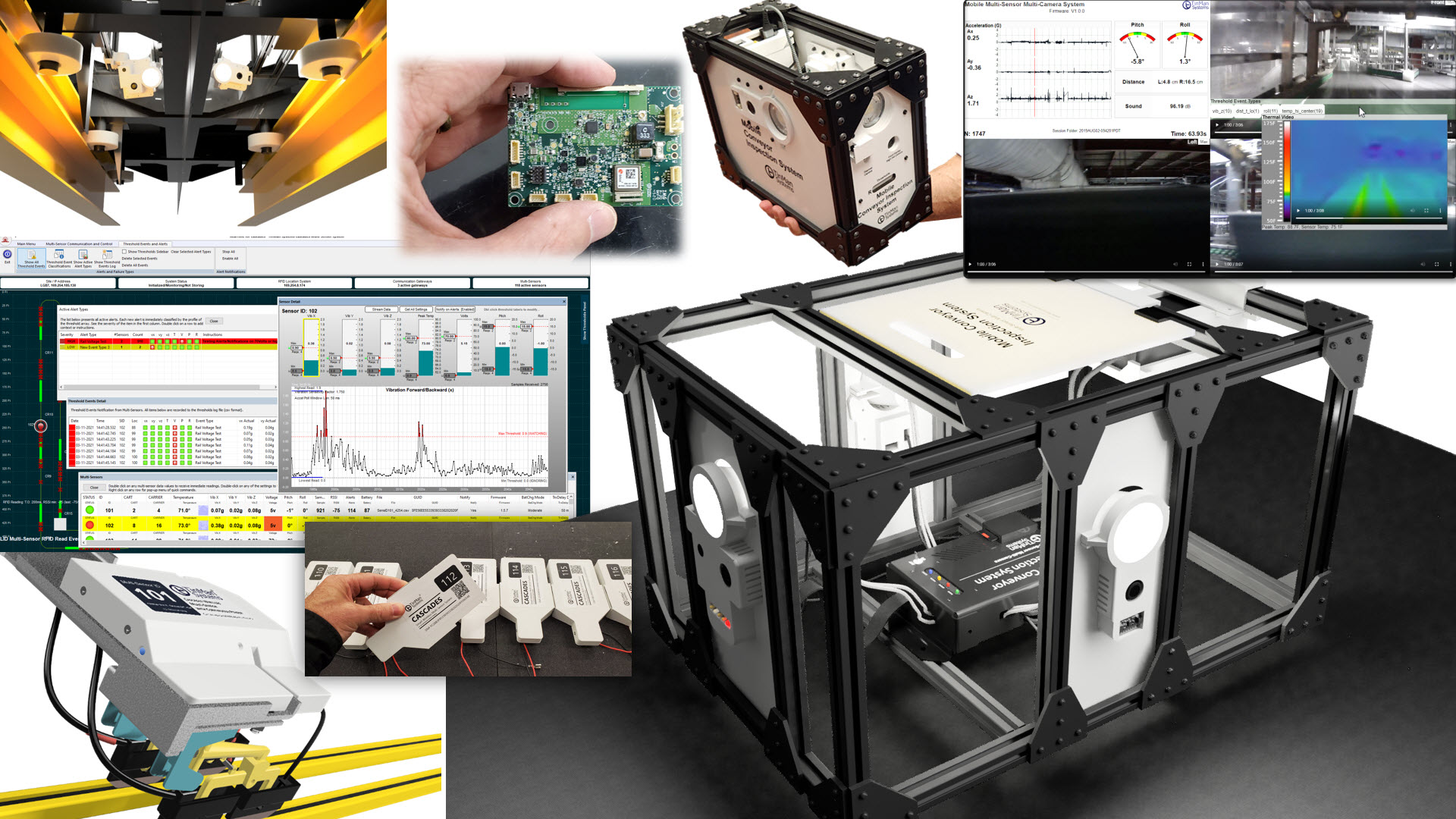
TinMan Systems’ real‑time software foundation has evolved into a complete sensing ecosystem designed for Predictive Maintenance and the singular purpose of keeping automation running. That evolution produced two complementary hardware families — each built on the same real‑time intelligence, but serving different operational needs.
The first lineage focuses on continuous monitoring through the Cascades Smart Wireless Sensor Systems. These compact multi‑sensor nodes provide always‑on vibration, temperature, acoustic, and IMU data, with optional external vision modules for enhanced inspection. They form the permanent sensing layer that gives automated systems a continuous, real‑time voice.
The second lineage supports routine high‑resolution inspection through systems such as MCIS and SORTERVision. These mobile, video‑enabled diagnostic tools deliver dense, synchronized sensor and camera data during inspection runs, revealing mechanical behavior with clarity and precision.
Together, these hardware paths — continuous monitoring and routine inspection — feed TinMan’s real‑time AI platform. The result is a unified, industrial‑grade sensing infrastructure that detects early degradation, prevents failures, and ensures that high‑throughput automation remains healthy, predictable, and productive.
Where We’re Going

TinMan Systems is building a global intelligence layer for automation — a connected network where every system, in every facility, can communicate its health, behavior, and performance in real time. As deployments expand across industries and geographies, the platform will unify data from continuous monitoring and routine inspection systems into a single, cloud‑connected hub.
This next step enables something transformative: cross‑site visibility, global equipment health, and performance benchmarking across entire fleets of automated systems. Companies will not only know when their equipment is degrading or about to fail — they will understand how their reliability compares to industry averages and to their own facilities worldwide.
From engineers on the floor to regional managers and corporate leadership, every user will have access to the same real‑time intelligence from anywhere in the world. TinMan Systems is creating the sensing and AI infrastructure for automation that is not only fast and efficient, but interconnected, comparative, and self‑aware.